


C1-04 Automotive parts evaluation and development for recycled material use
Principal Investigator
TSUGE Motoki (Toyota Boshoku Corporation)
Research Overview
In response to the urgent issue of the End-of-Life Vehicles (ELV) Regulation*1 proposal, we will develop prototypes of automotive parts using high-quality recycled materials developed by the SIP participating organizations. Adapting recycled materials to automotive parts is extremely challenging due to the strict safety and reliability requirements.
By identifying issues and presenting solutions in the SIP, we aim to propose a business model for the circular economy of plastics in our country and contribute to strengthening industrial competitiveness.
*1: End-of-life vehicles regulation: New rules for the design and end-of-life management of vehicles aim to protect the environment, decarbonize production and reduce raw material dependencies, benefiting EU industries.
Progress and results
We presented the target values for physical properties to the compounders of the SIP participating organizations, first selected the raw materials as a “quick flow” and presented the physical properties of the recycled materials obtained by adjusting the materials (compound) independently by the compounders, and compared the physical properties measured by Toyota Boshoku to identify issues for adaptation to the “door trim lower” of automotive parts at the current stage. One type of material was selected to be used for molding prototypes for the next stage, product performance evaluation.
The selected materials are made by adding 25% of recycled PIR*2 materials, and all of the target values of evaluation items (odor, VOC*3, light resistance test, glass haze, flammability, high-speed surface impact resistance) that meet the target values of physical properties and lead to product performance are also satisfied.
*2: Post Industrial Recycled
*3: Volatile Organic Compounds
In the molding prototype, molding is performed under the same molding conditions as the virgin material used in mass production. This recycled material could be continuously molded under almost the same conditions as the molding conditions in mass production. The coloring used the same coloring masterbatch as the mass production, and almost the same appearance as the mass-produced product was obtained. (Figure 1)
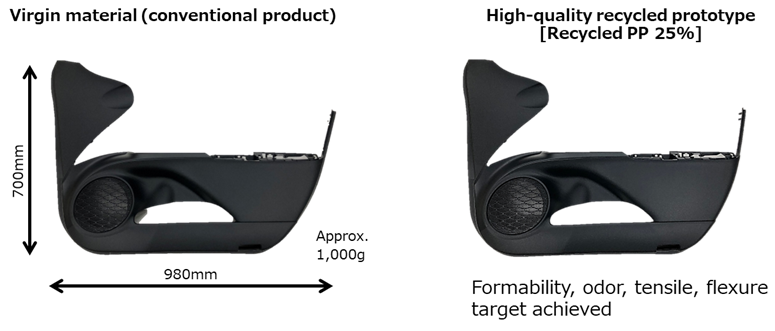
Fig.1 Door trim lower
Next, we evaluated the performance in the product state. There are four evaluation items: door trim single impact test, heat resistance test, cold heat repetition test, and drop weight impact test. All of them met the criteria and passed.
Figure 2 below shows the impact area of the door trim impact test, which is the most stringent test in product performance. To confirm the impact on the occupants of automobile parts against the impact of a side collision from the outside of the vehicle, the impact input area to the lower board is defined as shown in Figure 2, and the change in input load and the destruction status of the product are checked. A assumes an effect on the abdomen, B and C, on the lumbar region.
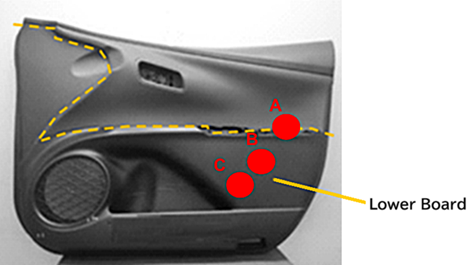
Fig.2 Door trim single impact test striking area
Although the recycled PP is PIR, we were able to demonstrate the possibility of using recycled materials for automobile parts by satisfying the product performance of the door trim lower with a material to which 25% recycled material is added.
In order to further expand the qualitative and quantitative base, materials using PCR*4 materials were re-adjusted (compounded) with a compounder that had not have reached molding prototypes due to problems with some of the evaluation items that lead to physical property targets or product performance in the “quick flow” and material evaluation.
The recycled material ratio was 20% and 25%, but both satisfied the target values for physical properties and the target values for evaluation items that lead to product performance. It is presumed that both materials are the result of improvements with an emphasis on impact resistance through feedback of the “quick flow”.
In addition, in the use of PCR materials, we had estimated that odors and VOCs would be major issues, but the results showed that the target values were satisfied and that they could be applied to automotive interior parts.
*4: Post Consumer Recycled
To expand the range of components to which recycled materials can be applied, this study investigated the applicability of recycled materials to automotive interior parts other than door trim. Product evaluations were conducted using scuff plates, which have relatively lower performance requirements than lower door trim components and are therefore considered promising candidates for expanded use of recycled materials. (Figure 3)
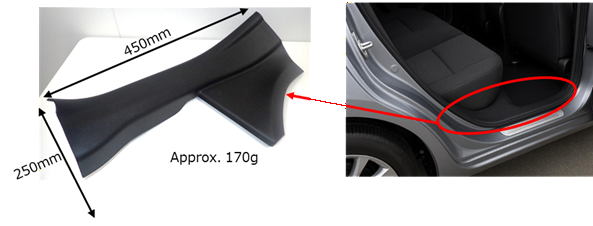
Fig.3 Scuff plate
PCR recycled material was compounded at addition rates of 25%, 30%, 50%, and 70%. Among these formulations, those containing 25% and 30% recycled material satisfied both the target mechanical property requirements and the product-related evaluation items, including odor, VOC (volatile organic compounds), light resistance, glass haze, and flammability.
In contrast, formulations with 50% and 70% recycled material exhibited odor-related issues, which had been identified as a key concern.
Based on these results, scuff plates were molded using materials containing 25% and 30% recycled content, and product-level evaluations were conducted. In initial dimensional measurements (prior to exposure to environmental conditions such as heat), the scuff plates containing 25% recycled material showed slight dimensional differences compared to those made from 100% virgin material; however, these differences were judged to be within an acceptable range through optimization of molding conditions.
In contrast, scuff plates containing 30% recycled material showed larger dimensional deviations, indicating a high likelihood that countermeasures at the mold design level would be required.
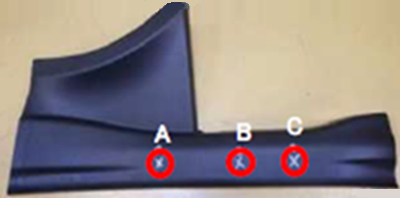
Fig.4 Drop position of the drop-weight impact test
Impact resistance, which was identified as a potential concern, was evaluated using a drop-weight impact test (Figure 4). The scuff plates containing 25% recycled material exhibited impact performance equivalent to that of 100% virgin material. Although the scuff plates containing 30% recycled material showed slightly reduced impact resistance, it was determined that equivalent performance could be achieved through design optimization, such as modifications to the rib structure on the rear side of the product (e.g., rib layout and thickness).
The European ELV Regulation proposes a target of 25% recycled material usage in new vehicles, making timely compliance with this regulation increasingly important. The results of this study indicate that, regardless of whether PIR or PCR materials are used, the application of recycled materials at an addition rate of up to 25% is technically feasible for many automotive interior parts.
Therefore, it can be concluded that technical compliance with the proposed ELV Regulation is achievable at the current stage.