


A2-02 Research on development and demonstration of matching tool for recycled plastics
Principal Investigator
ARAI Rie (Mitsubishi Research Institute, Inc)
Research and Development Overview
For the expansion of the recycled plastics market, it is essential not only to have the matching function between supply and demand, but also for businesses at each stage of the use and supply of recycled plastic and the collection of plastic waste as raw material to accumulate data and know-how for expanding the quantity and improving the quality of recycled plastics, and to utilize this as shared knowledge.
With the matching application of recycled plastics as the core, this research aims to expand the use of recycled plastics in society and to realize circulation of plastics quickly, by creating the platform for sharing data and know-how about the use of recycled plastics in cooperation with various businesses.
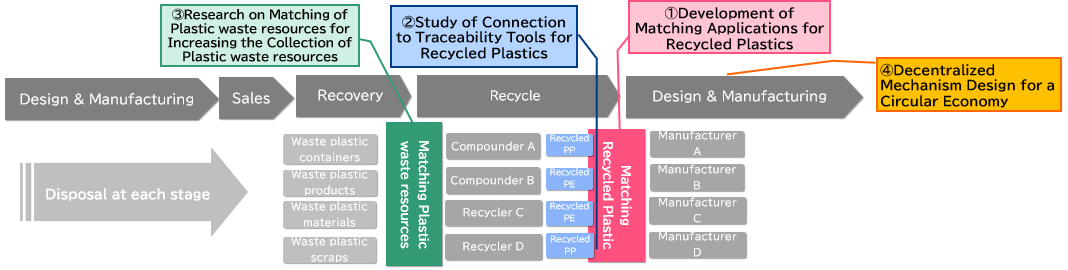
The following four research projects are carried out for the above-mentioned purposes.
- Development of Matching Applications for Recycled Plastics
Developing a matching application based on the information that recycled plastic suppliers have and that recycled plastic users need. Conducing a demonstration of trial use of recycled plastic by utilizing the application, and improving the application based on the results.
- Study of Connection to Traceability Tools for Recycled Plastics
As a measure to ensure traceability necessary to improve the reliability of recycled plastic, a connection with information sharing platforms for plastics and other traceability tools is studied. Based on the results of the study, an interface for connecting to each tool is implemented in the matching application.
- Research on Matching of Plastic waste resources for Increasing the Collection of Plastic waste resources
Investigate the information necessary for recyclers, equivalent to recycled plastic suppliers, to procure plastic waste resources, which are raw material resources, and the information that plastic waste resources provider can grasp and provide, and consider the necessary information items and forms for matching both parties. Based on this consideration, explore and verify the possibilities of app development.
- Decentralized Mechanism Design for a Circular Economy
Presenting a grand theory for sustainability by developing an auction method to match supply and demand of recycled plastics and proposing an institutional design to make the circular economy work effectively.
Progress and Achievements
- Development of Matching Applications for Recycled Plastics
After developing and modifying a simple matching application for recycled plastics, a full-scale verification experiment using a matching application for recycled plastics began in October 2024. As of the end of FY2025, a total of eight types and 51 listings of recycled plastics—mainly PP and PE—were registered on the app.
The number of participating companies, including recycled plastic suppliers and users, reached a total of 28. Over the course of the entire demonstration project, four meetings were held between suppliers and users, and three cases of sample exchanges were conducted. (Including the outcomes of the matching approach in which suppliers proactively reach out, as described later.)
Meanwhile, through the demonstration, it was confirmed that issues such as the fact that the quality and quantity of recycled materials registered do not necessarily align sufficiently with the needs of user companies have constrained the progress of matching.
In addition, in order to enhance the potential for matching, a questionnaire survey on app usage was conducted among participating companies. Based on the opinions and requests collected, a matching approach was piloted in which suppliers proactively contacted users based on the “minimum necessary information” provided by users to assess the feasibility of using recycled materials.
As a result, this approach led to the creation of a total of two meetings between supplier and user companies, one of which progressed to the exchange of samples, thereby confirming a certain level of effectiveness in advancing matching.
- Study of Connection to Traceability Tools for Recycled Plastics
Conducted exchanges of views with the project members responsible for R&D Project A1-01: Development of PLA-NETJ, and A2-01: Requirement Definition and Rule Formation for PLA-NETJ, regarding the progress of each project and specific considerations for system integration.
Involved in the study of the definition of data format requirements in the “Guidelines for Establishing an Information-Sharing Platform for Plastics Preliminary Draft (Discussion Paper)" released in January 2025. Provided data items used in 1., and coordinated them with the data items in A1-01 and A2-01.
Furthermore, it was confirmed that, between the two systems, the correspondence among major data items—including item names, definitions, and description formats—can be broadly organized and adjusted.
- Research on Matching of Plastic waste resources for Increasing the Collection of Plastic waste resources
To expand the collection volume of plastic resources, on‑site surveys were conducted to explore the feasibility of matching plastic resource treatment operators with recyclers (equivalent to recycled plastic supply businesses). Based on the survey findings, the focus was shifted to examining the matching potential between plastic resource generators and recyclers (equivalent to recycled plastic supply businesses).
Recognizing the need to collaborate with entities that possess information on waste‑generating businesses, discussions were held with a company operating a waste management system for waste generators. As a result, a “Plastic Resource Matching Demonstration Project” was launched in collaboration with this waste management system provider to promote matching between plastic resource generators and recyclers.
From May 2025, requests for cooperation in the demonstration project were extended to recycled material suppliers registered on the app, and matching approaches were piloted toward waste generators of interest to the suppliers. Consequently, one supplier visited a waste generator’s facility to inspect the generated waste and storage conditions.
- Decentralized Mechanism Design for a Circular Economy
Collected information on auction theory, economics related to recycling, and other non-economic areas (e.g., LCA).
From FY2025 onward, began design and development of an auction system that will contribute to the establishment of a circular economy system, and formulated a preliminary framework for a “Set-Aside Scoring Auction.”
Set-aside scoring auction is a newly designed bidding mechanism that incorporates considerations such as impacts on livelihood foundations, social infrastructure, and institutional foundations, firms’ short-term and long-term contributions to reducing environmental burdens, and the traceability of accountability through Digital Product Passports (DPP).
It is designed so that a combinatorial auction can be connected to an information infrastructure that enables these factors to be evaluated and reflected in the allocation process.
Overview of Research and Development