


C1-01 Development of environmental testing, diagnosis, and tracer technologies and digital analysis platform for industrial applications
Principal Investigator
NAITO Masanobu(National Institute for Materials Science)
Research and Development Overview
Mission 1: Build a digital platform for information sharing
- Establish a research and development base for CE plastic materials as the SIP-CE lab at the National Institute for Materials Science (NIMS) and build a digital analysis base to promote collaborative research between industry, government and academia related to CE and strengthen industrial competitiveness.
Mission 2: Develop technology to realize manufactures-recyclers collaboration
- Promote collaboration between recycler and manufacturer for the circular economy by establishing tracer molecules and odor identification and detection technology for recycled materials.
Mission 3: Develop technology and create an environment to promote innovative circulation in the circular economy
- Develop circular materials based on network polymers with dynamic cross-linking structures. Also, establish environmental testing and diagnostic technology using material informatics, and tracer technology to track the sustainability of plastic products.
- Carry out research and development on circular economy materials for automotive plastics to meet sustainability requirements in automobile design and end-of-life vehicles (ELV) management.
Progress and Results
Development of a Data-Driven “Grading” Technology for Recycled Plastics:
Contributing to the Circular Economy through the Integration of Non-Destructive Testing and AI
Background and Objective
To achieve a circular economy for plastics, it is essential to expand material recycling, in which used plastics are reused as raw materials for new products. However, recycled plastics such as recycled polypropylene (rPP), collected from households and industrial waste streams, originate from a wide variety of products and possess different histories of thermal, mechanical, and photo-induced degradation. As a result, recycled plastics often exhibit large variations in quality, including mechanical strength and stiffness.
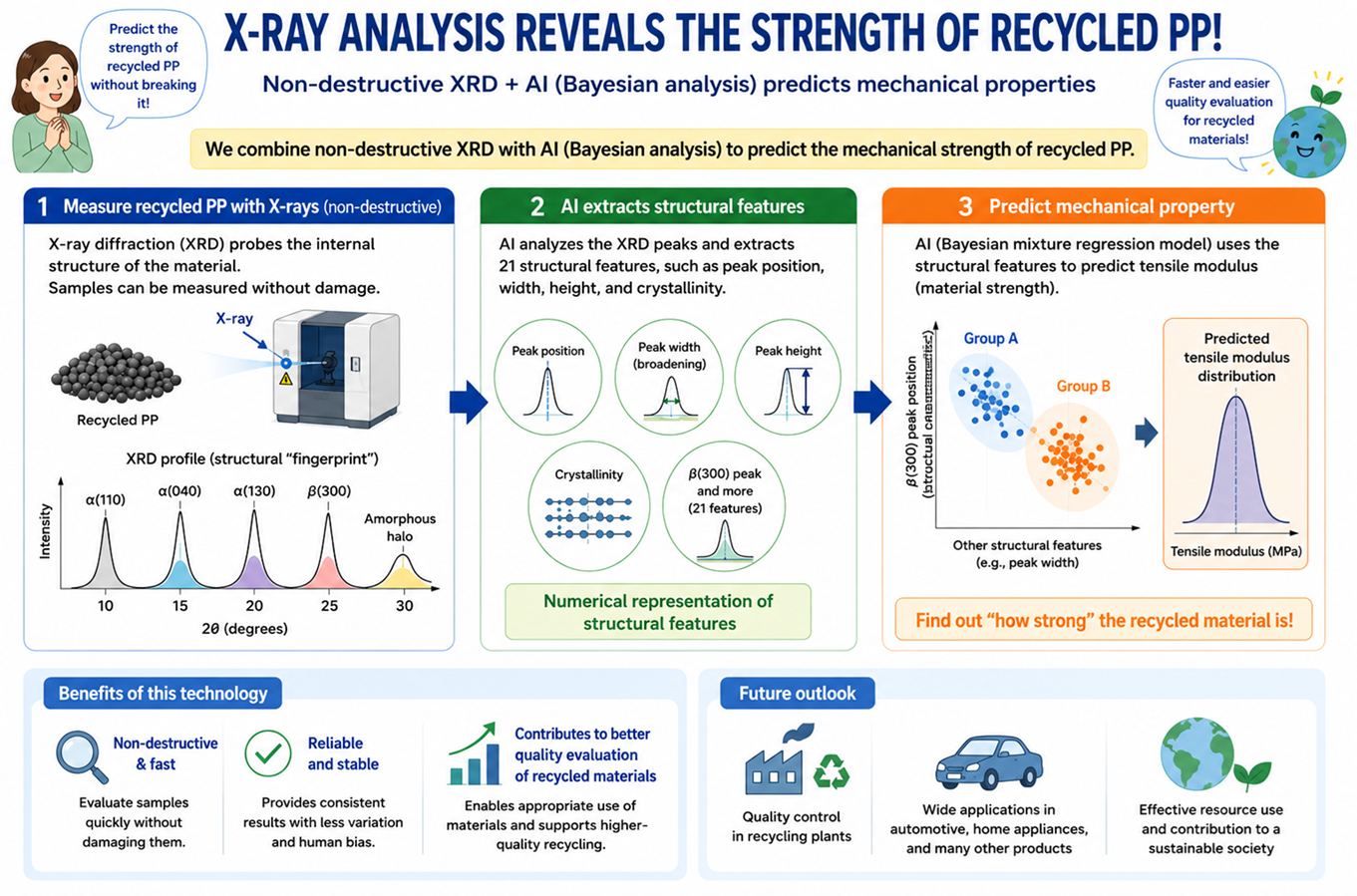
In this study, we aimed to establish a digital platform capable of accurately predicting and “grading” the mechanical stiffness (tensile modulus) of recycled plastics from their crystalline structural features without destroying the products.
Developed Technology and Digital Platform Construction (Materials Informatics Approach)
We developed a new analytical framework that combines:
X-ray diffraction (XRD), which probes the internal crystalline structure of materials, and Bayesian statistical AI modeling, an advanced probabilistic machine learning approach.
Automated Extraction of Structural Features by AI
From complex XRD patterns, the AI system automatically extracted 21 physically meaningful microscopic structural descriptors, including:
- disorder in crystal lattice structures,
- peak broadening,
- crystallinity,
- and the fraction of amorphous regions.These descriptors enabled quantitative representation of subtle structural differences in recycled plastics.
Mixture Regression Modeling and High-Speed Exploration (REMC)
To handle the highly heterogeneous nature of recycled plastics, we constructed a system that simultaneously:
- classifies samples into appropriate structural clusters, and
- predicts mechanical properties for each cluster.The analysis employed an advanced computational technique called Replica Exchange Monte Carlo (REMC), enabling the AI model to avoid local optima and identify intrinsic relationships hidden within complex datasets.
Key Results and New Scientific Insights
- High Prediction Performance
We successfully developed a model capable of explaining the tensile stiffness of diverse polypropylene samples with different degradation histories and compositions with high reproducibility. Discovery of Microscopic Factors Governing Mechanical Stiffness
Conventionally, the stiffness of polypropylene has often been attributed mainly to the amount of a specific crystal phase known as the β-crystal.However, the present AI-driven analysis revealed a new insight:
For certain structural clusters, the lattice distortion and local structural disorder of β-crystals had a stronger influence on stiffness than the simple quantity of β-crystals alone.This finding provides a new perspective on the structure–property relationship in recycled polypropylene.
Social Implementation and Contribution to the Circular Economy
This technology serves as a core component of a digital grading platform for reliable recycled plastics.
Conventional mechanical testing requires destructive preparation of test specimens. In contrast, the present approach digitally interprets the microscopic structural information of recycled plastics through non-destructive XRD measurements and AI analysis.
This enables rapid and reliable quality grading, such as:
- “This recycled plastic lot is suitable for automotive components,” or
- “This material is appropriate for consumer products.”
By enabling appropriate material selection based on structural information, this technology is expected to accelerate the practical utilization of recycled plastics that have traditionally been avoided because of inconsistent quality.
Ultimately, the developed framework contributes to the realization of a fully circular plastics economy through data-driven quality evaluation and intelligent resource utilization.