

C1-02 Development of a recycled plastics databank to improve the circularity
Principal Investigator
TAKATA Masaki (Tohoku University)
Research and Development Overview
To return waste plastics to materials with physical properties similar to those of virgin plastics, it is first necessary to clarify the physical properties and structure of recycled plastics in their current state.
Accumulation of property and structure data is essential to promote the sustainable use of recycled plastics (quality assurance and improvement of recyclability) based on scientific analysis.
The objective of our research group is to analyze and improve the quality of recycled materials by integrating physical properties/structural measurement, computation, and data-driven science, and to establish a databank center that accumulates analytical data necessary for improving recyclability. The following contents are being researched and developed.
- Quality analysis of recycled polypropylene (PP) is conducted by evaluating physical properties and measuring structure, and quality improvement is carried out based on the results.
- Various data on virgin PP, current recycled PP, and improved recycled PP will be accumulated, and the correlation between physical properties and structure will be analyzed using data-driven science.
- To build a data bank of recycled PP by accumulating physical properties and structural data in association with data on recycled material fabrication requirements related to the Digital Product Passport (PLA-NETJ).
Guideline for Sample Preparation and Acquisition of Physical and Structural Data for Registration in the Recycled Material Data Bank
The Recycled Materials Data Bank has been developed as part of the SIP project 'Development of Circular Economy System', with the aim of establishing a quality evaluation platform for recycled polypropylene (PP).
Following the data acquisition procedures specified in the guidelines attached below, film and injection-molded samples were prepared, and a wide range of physical and structural properties was measured, including lightness, density, Young’s modulus, yield stress, elongation at break, Charpy impact strength, melting point, PP crystallinity, PE and PS indices, SAXS integrated intensity, foreign substance content, and decomposition onset temperature.
These parameters collectively represent essential baseline data that reflect the purity, degradation state, contaminant levels, crystalline structure, and mechanical properties of recycled materials. The multidimensional dataset obtained was analyzed using a Self-Organizing Map (SOM), allowing samples to be automatically clustered based on correlations among material characteristics.
Based on these clusters, materials were classified into A grades suitable for horizontal recycling and B grades for cascade recycling, further subdivided into A1–A5 and B1–B5 categories.
This system provides a grading scheme that systematically evaluates diverse physical and structural features of recycled materials and enables immediate assessment of their suitability for specific applications. To enhance transparency and usability, the data acquisition guidelines and grading criteria are published as supplementary documents.
Looking ahead, the scope of this platform will be expanded beyond PP to include other resins, advancing toward a comprehensive and systematic evaluation framework for recycled materials.
DATA BANK Guideline(PDF, 723KB)
For comments and inquiries about the DATA BANK Guideline, please contact
Takahiko KAWAI (Tohoku University)
takahiko.kawai.a7[]tohoku.ac.jp
*Please convert [] to @
For comments and inquiries about the Grading table, please contact
Keiichi SHIRASU (Tohoku University)
keiichi.shirasu.c1[]tohoku.ac.jp
*Please convert [] to @
Progress and Achievements
- Implementation item 1:
Quality analysis of recycled materials: We obtained 20 types of virgin PP and about 100 types of recycled PP derived from containers, home appliances, automobiles, PET bottle caps, containers, battery cases, etc., and obtained physical properties and structural data. - Implementation item 2:
Quality improvement of recycled material: We started to study the development of a new polymer blend of recycled PP by changing the blend ratio with virgin PP while adjusting the MFR*1. Injection molding samples of the blended material were evaluated, and it was found that the material was efficiently modified by blending with virgin PP of high crystallinity.
*1 Melt Flow Rate; Indicator of polymer's flow capability - Implementation Item 3:
Development of a recycled plastics databank: A self-organizing map (SOM) was created for 65 types of PP containing virgin material out of the samples analyzed for quality, and grading of recycled materials was conducted.
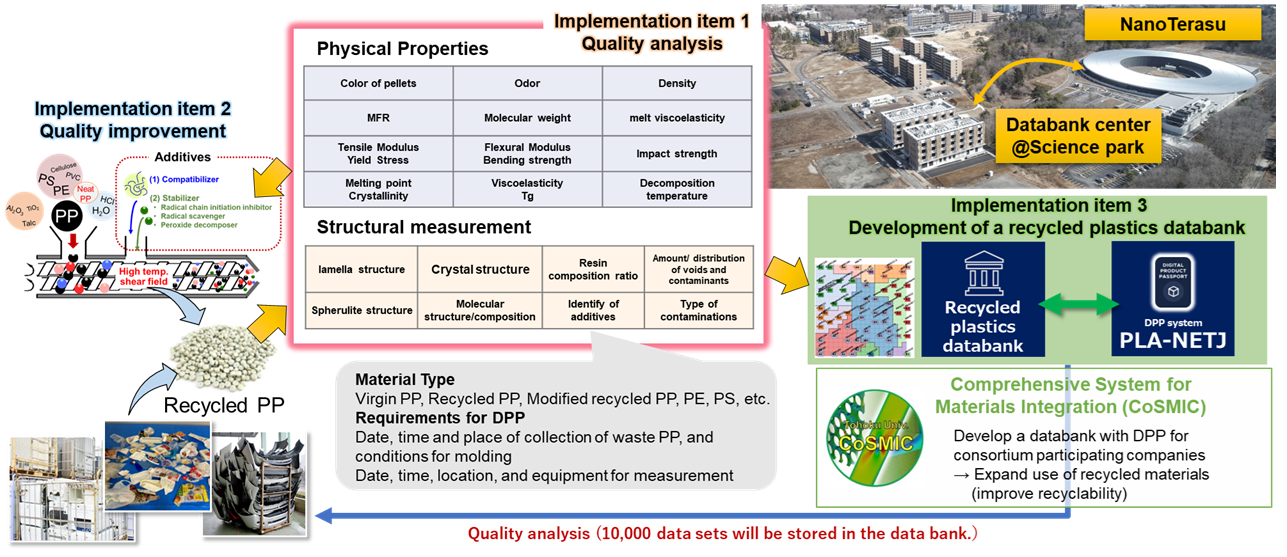
Overview image of Research and Development