



C1-08 Utilizing recycled materials in vehicle exterior plastic parts
Principal Investigator
SATSUKAWA Isao (UNIPRES Corporation)
Research and Development Overview
To realize compliance with the proposed ELV (End-of-Life Vehicles) regulation*1, we are developing automotive exterior components using recycled materials produced by the participating institutions of this SIP program.
Beyond standard injection molding, we aim to expand the applicability of various recycled materials by utilizing our proprietary plastic parts press molding technologies—USM*2 and USS*3 processes.
Through these efforts, we contribute to increasing the utilization rate of recycled materials in the automotive industry.
*1 End-of-life vehicles regulation: New rules for the design and end-of-life management of vehicles aim to protect the environment, decarbonize production and reduce raw material dependencies, benefiting EU industries.
*2 USM: Unipres Stamping Molding process
*3 USS: Unipres Sheet Stamping process
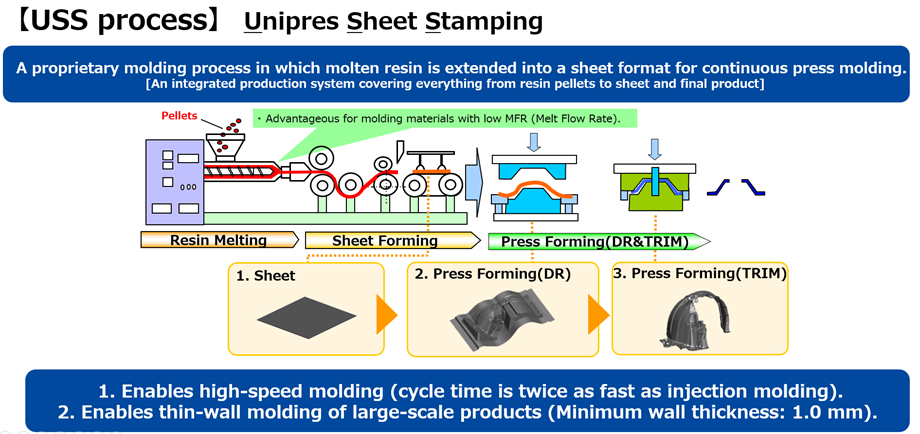
Overview of plastic parts press molding process (USS process)
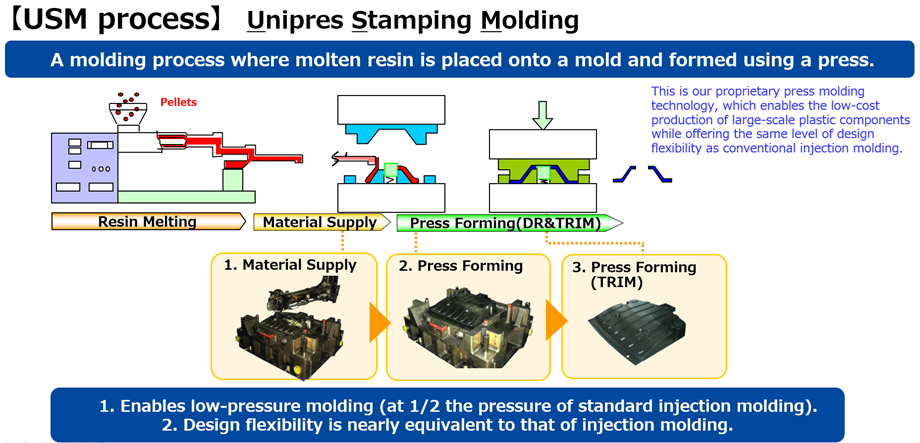
Overview of plastic parts press molding process (USM process)
Progress and results
We prioritized the verification of recycled materials for practical social implementation, which is the core of this project. Specifically, we selected and adopted recycled materials from four companies that met the technical specifications required for this research. Using these materials, we conducted prototype molding trials and quality/performance evaluations for an automotive exterior "undercover" component using the USM process.
For all four selected recycled materials (with a PCR*4 content of 25% to 50%), we performed molding trials utilizing existing mass-production molds. The results confirmed that these materials could be processed under standard mass-production conditions. Regarding product quality, while the odor and appearance were equivalent to those of mass-produced parts, some areas did not satisfy specific dimensional accuracy standards. We conclude that adjusting for factors such as material shrinkage rates remain a critical challenge.
Furthermore, individual product performance tests were formulated and conducted based on the standards prescribed by OEM*5. The results confirmed that the components achieved performance levels equivalent to those of current mass-produced products.
*4 PCR: Post Consumer Recycled
*5 OEM: Original Equipment Manufacturer
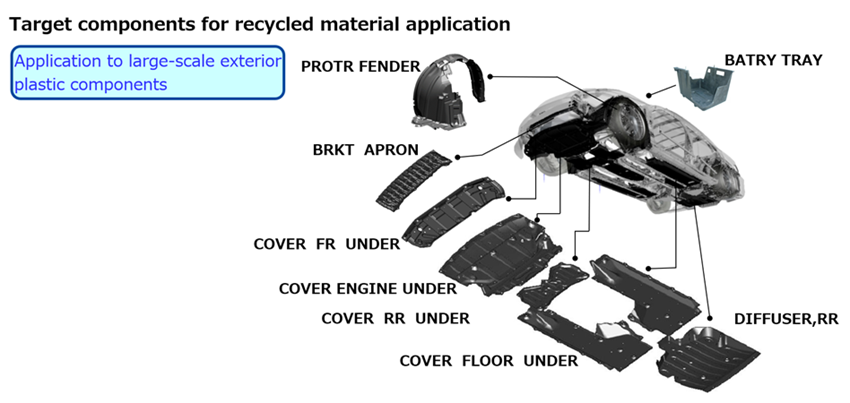
Overview of components for recycled material application