


C1-10 Pilot project for applying recycled packaging-derived resin to home appliances
Principal Investigator
MATSUDA Genichiro (Panasonic Holdings Corporation)
Research and Development Overview
Our group has been promoting plastic recycling initiatives based on the concept of “from products to products,” in which resources recovered from end-of-life products are reused as materials for new products (Figure 1).
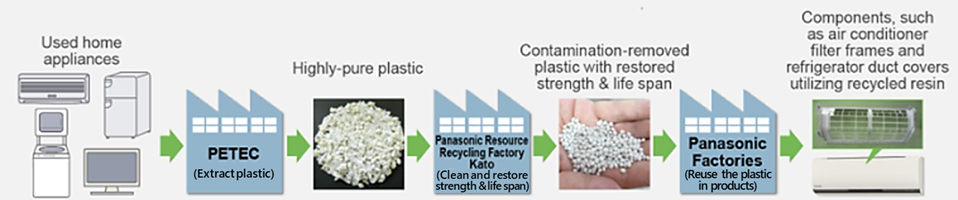
Figure 1 Process of Resin Recycling
To further expand resource circulation, this project focuses on recycled plastics derived from containers and packaging, which represent a key priority area in recycling. Containers and packaging account for a large volume of plastic usage and have relatively short lifetimes, resulting in a significant amount of waste plastics. Through this SIP program, we aim to establish a new recycling model: “Packaging-to-Appliance.”
However, compared with plastics derived from used home appliances, recycled plastics from containers and packaging require additional considerations in terms of material performance due to factors such as contamination, multilayer structures, coloration, and odor. In addition, their properties tend to be less stable.
To address these challenges, we will pursue social implementation of the “Packaging-to-Appliance” model through the following three activities:
- Activity 1: Material characterization
- Activity 2: Development of material modification formulations
- Activity 3: Application to home appliance products
In FY2025, we conducted Activity 1 to understand the fundamental properties of recycled plastics derived from containers and packaging.
Progress and Achievements
In FY2025, we investigated recycled plastics from containers and packaging that are potentially applicable to home appliances. Five types of recycled resins provided by multiple recyclers were evaluated, and fundamental material properties—including material composition, mechanical properties, and thermal properties—were characterized.
Based on the evaluation results, multiple materials with distinct characteristics were selected, and a matrix study was conducted using five types of additives under three different formulation levels. This enabled us to clarify the effectiveness of modification for each material as well as the limitations for application.
On the other hand, chemical analyses (e.g., NMR and GPC) suggested that the presence of polyethylene (PE) contamination and random polypropylene (PP) may be factors that hinder the stabilization of material properties. Going forward, we will further investigate potential improvements through blending with virgin materials and the application of compatibilizers for PE/PP systems.