

A2-03 Action research on behavioral change of consumers for the construction of appropriate resource circulation systems for plastics
Principal Investigator
ASARI Misuzu (Research Institute for Humanity and Nature)
Research and Development Overview
To achieve a resource circulation of the diverse plastic products taking the environment and SDGs (Sustainable Development Goals) into consideration, collaboration among stakeholders across the value chain and changes in consumer awareness and behavior are essential. This research project aims to investigate consumer awareness and behavior regarding plastic products, and to develop methods for identifying optimal measures for different categories of plastic products. This will be achieved by organizing environmental and SDGs-related information to be provided to consumers through platforms such as PLA-NETJ (Plastic Networking Environmental Transformation Japan) developed within this SIP and other initiatives. Additionally, we will set up model regions and stores to analyze and simulate behavior changes among stakeholders across the value chain, mainly consumers and retailers. Furthermore, we develop educational programs related to the circular economy, aiming to contribute to promotion of behavior change and fostering momentum among consumers, in a way that can also be applied to areas beyond plastics.
Environmental Education Program "Pla-School"
An environmental learning facility and program specializing in plastics has been opened within the Kyoto Satoyama SDGs Lab "Kotos " , which uses an abandoned school (Reference). This is an original exhibit and program where citizens can learn about the history of plastic resources, the various types, issues, and circulation systems. Inspired by the settings of an abandoned school, the program, which resembles various subjects, includes not only classroom lessons but also excitement and dialogue.
The aim is to provide a place and opportunity for citizens to learn about the importance of plastic resources, the significance of recycling, and the latest trends, leading to changes in awareness and behavior. Plastics are used by everyone in a variety of situations. For this reason, programs can be customized according to the target participants, from elementary school students to seniors, and for citizens with and without prior knowledge or interest.
In addition to reflecting the research findings of the project collaborators, this program also receives information and exhibits from other participants (Amita Holdings Co., Ltd., Menicon Co., Ltd., Toyama Kankyo Seibi Co., Ltd., and Ryohin Keikaku Co., Ltd.) of the SIP.
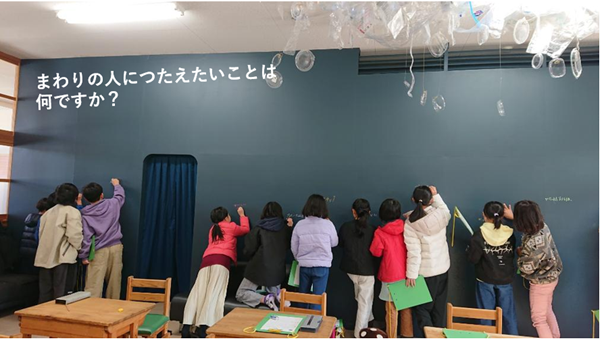
Elementary school students writing down “what they want to share with others” after experiencing the program.
Completion of the "Feelings of the Plastics Game" Furoshiki and its promotion at the EXPO2025
We developed the “Feelings of Plastics Game”, a board game that follows the life cycle of plastics. The game is designed as an educational tool to help participants see plastic resource circulation as something personally relevant and to encourage changes in awareness and behavior.
The game was developed through repeated discussions with educators, experts, and businesses involved in different stages of the plastic life cycle. Version 1 of the “Feelings of Plastics Game” focuses on PET bottles and has been printed on a furoshiki wrapping cloth made from 100% recycled PET bottle resin.
We also adopted “CiReta!”, a digital platform developed by digglue Inc. By scanning 2D barcode, consumers can access information on materials, environmental and SDGs indicators, and appropriate use or circulation of the product.
Hundreds of participants, from elementary school students to adults, have experienced the game so far. The responses have been highly positive, and questionnaire surveys have shown that dialogue through game experience can lead to changes in awareness.
Recognized for its uniqueness and innovative approach, this educational tool was introduced through multiple programs at the Expo 2025 Osaka, Kansai, Japan site. It is also being lent or provided to schools and educational facilities, and its use is spreading across Japan.
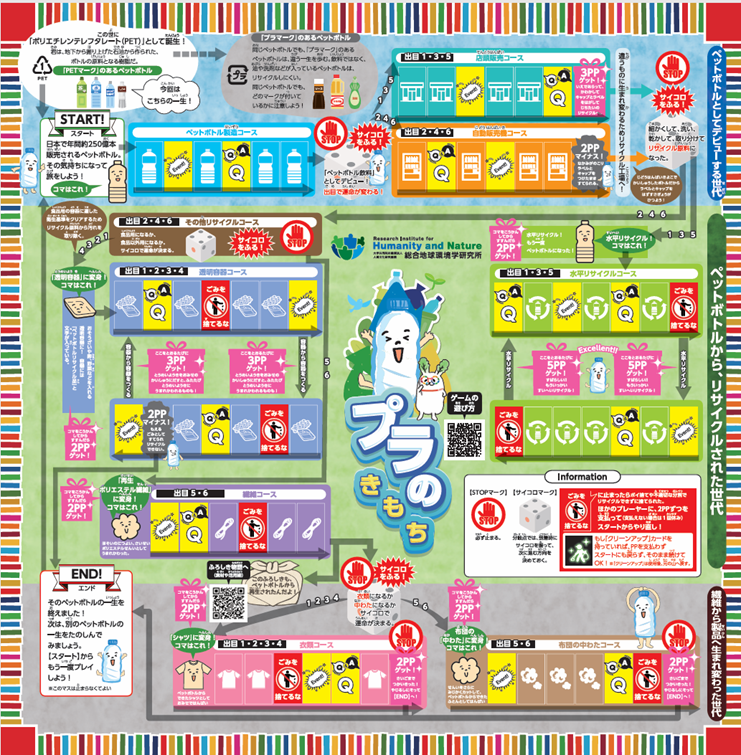
"Plastic Feelings Game" Furoshiki
Development and demonstration of an educational program in collaboration with Ryohin Keikaku Co., Ltd. (MUJI) and an elementary school
As a model of in-depth education in which the local community collaborates with school education, an educational program was developed in collaboration with MUJI and Kyoto Municipal Anshu Elementary School. Targeting fifth graders, MUJI staff members, in addition to university professors and graduate students, taught classes and acted as mentors, and the program taught students about the life cycle of products and sustainable consumption. Students actually visited MUJI stores, personally identified products that were considerate of resource circulation, and created posters to encourage behavioral change of adults.
Modeling consumer awareness and behavior
We are developing methods to encourage consumer behavior change by promoting environmental and SDGs information about products made from recycled plastics. In collaboration with MUJI, we conducted an awareness survey on store collection and analyzed consumer purchasing behavior when carbon footprints were presented. We also developed a method to calculate environmental and SDGs indicators and evaluated five environmental impact items and eight social impact items for multiple products.
As a result of these efforts, the following became clear. We are currently working on publishing these findings as papers and at the same time organizing the information in an easy-to-understand publication.
- Consumers will change their behavior when they are presented with an appropriate amount of information about the significance of resource circulation, etc.
- As there are many consumers who are sensitive to human rights issues, it would be meaningful to present that recycled plastics are excellent at respecting human rights in terms of environmental and SDGs indicators.
- Depending on the product, some plastics are suitable for recycling and others are not, so it is meaningful to consider this on a product-by-product basis.