


C1-06 Performance and Quality Evaluation of Recycled Materials for Automotive Parts
Principal Investigator
YAMADA Hiroaki(DaikyoNishikawa Corporation)
Research and Development Overview
We are evaluating the performance and quality of automotive parts to determine the suitability of recycled materials, thereby contributing to the accumulation of the recycled plastics databank for the establishment of an X-to-Car recycled-material circular economy system.
In recent years, there has been a growing shift from the linear economy—characterized by resource extraction, mass production, and mass disposal—to the circular economy that aims to reduce resource input and consumption while minimizing waste generation. In the automotive industry, the European Union (EU) is revising the proposed End-of-Life Vehicles (ELV) Regulation on vehicle design and end-of-life management, including requirements such as minimum recycled plastic content in new vehicles, and the mandatory use of recycled materials in automobiles is expected to expand globally in the future. Against this background, the SIP initiative “Development of a Circular Economy System” has identified, as one of its research themes, the establishment of a recycling system capable of stably supplying high-quality recycled plastic materials for automotive parts. To achieve this objective, automotive parts manufacturers and recycled-material feedstock suppliers are collaborating on the prototyping and verification of automotive parts using recycled materials.
Progress and Achievements
We selected an engine oil strainer—considered difficult to commercialize using recycled materials—and a side garnish requiring high painted surface quality as verification components (Figure 1).
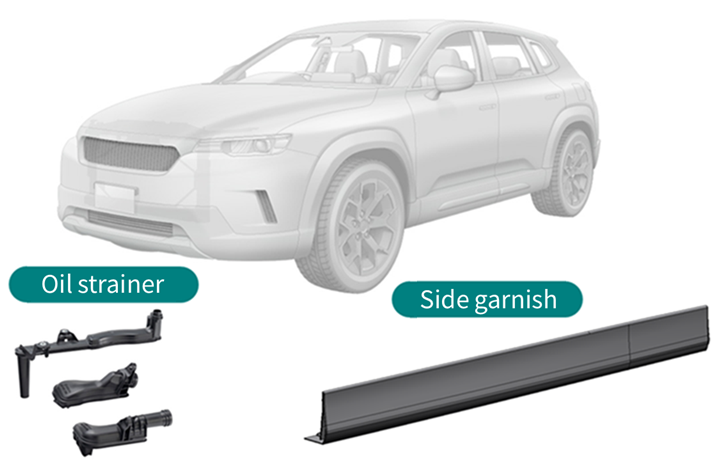
Fig.1 Verification components for recycled material application evaluation
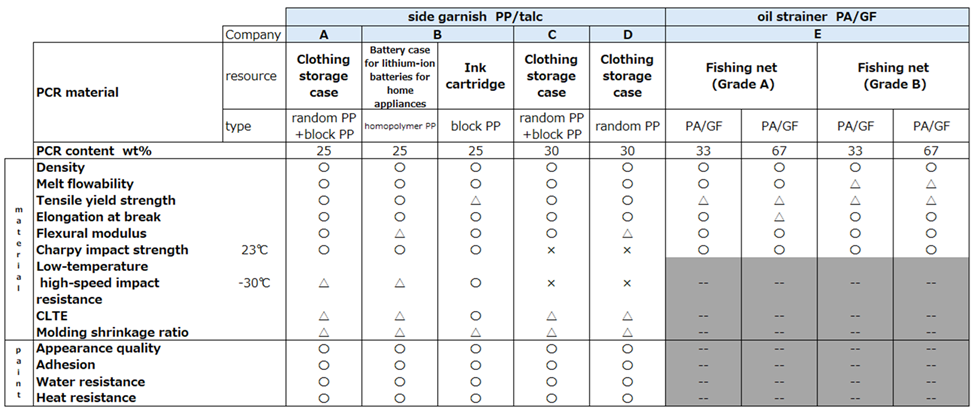
Target property values for recycled materials were set based on the performance targets defined by the Japan Automobile Manufacturers Association. Each material manufacturer conducted trial production of recycled materials meeting these target values. Using waste plastic materials supplied by the material manufacturers, we performed fundamental evaluations of the recycled materials using an in-house flat-plate prototype mold, including moldability, appearance quality, and basic material properties, as well as paint adhesion evaluations assuming exterior automotive components (Table 1).
As a result of prototype evaluations using in-house flat-plate specimens, favorable results were obtained in terms of moldability, appearance quality, and paint adhesion for exterior automotive applications at a PCR (Post-Consumer Recycled) content of 25–30%. On the other hand, we identified dimensional change behavior due to thermal expansion and contraction, thermal aging resistance, and impact performance as factors that could lead to degradation of product performance. Going forward, in order to transition to product-level evaluations, we will consult with each material manufacturer and formulate a product verification plan for fiscal year 2026.
Table.1 evaluation result